Metrics notebook
[1]:
# Notebook display options, change as your preference/system
%matplotlib inline
%config InlineBackend.print_figure_kwargs={'facecolor' : "w",'bbox_inches':None}

import matplotlib as mpl
mpl.rcParams['figure.dpi'] = 120
[2]:
# Notebook display options, change as your preference/syste

import sys
sys.path.insert(0,'..')
sys.path.insert(0,'../..')

from matplotlib import pyplot as plt
import numpy as np

from scipy.constants import micro, nano, milli

import pyMOE as moe
from pyMOE.generate import *
from pyMOE.propagate import *
from pyMOE.metrics import *
from pyMOE.optimizer import *
from pyMOE.ensemble import *
[3]:
# These metrics could be used to build specific loss functions
[4]:
#number of pixels
x_pixel = 100
y_pixel = 100


#size of the rectangular mask
aperture_width  = 50e-6 #m
aperture_height = 50e-6

pixsize = 1e-6 #m

wavelength = 500e-9 #m
focal_length = 200e-6

zmin = wavelength
zmax = 1.2* focal_length
nzs = 500

radius = aperture_width/2

# Create Aperture
aperture1 = moe.generate.create_empty_aperture(-aperture_width/2, aperture_width/2, x_pixel, -aperture_height/2, aperture_height/2, y_pixel)

# Populate Aperture with Fresnel mask
mask1 = moe.generate.fresnel_phase(aperture1, focal_length, wavelength )

#moe.plotting.plot_aperture(mask1)


##############
###Fresnel mask with a truncated circular aperture

# Create empty mask
aperture2 = moe.generate.create_empty_aperture(-aperture_width/2, aperture_width/2, x_pixel, -aperture_height/2, aperture_height/2, y_pixel)


# and truncate around radius
mask2 = moe.generate.fresnel_phase(aperture2, focal_length, wavelength, radius=radius)
#moe.plotting.plot_aperture(mask2)

# Discretize mask in number of levels
# Select exact position of contours  in phase
phase_vals = np.linspace(-np.pi, np.pi, 16)

mask2.discretize(np.array( phase_vals)[:] )
#moe.plotting.plot_aperture(mask2)

# Generate a uniform field
field = moe.field.create_empty_field_from_aperture(mask2)

field = moe.field.generate_uniform_field(field, E0=1)

# Modulates the field
field = moe.field.modulate_field(field, amplitude_mask=None, phase_mask=mask2 )


# Create Aperture
aperture1 = moe.generate.create_empty_aperture(-aperture_width/2, aperture_width/2, x_pixel, -aperture_height/2, aperture_height/2, y_pixel)

# Populate Aperture with Fresnel mask
mask2 = moe.generate.fresnel_phase(aperture1, focal_length, wavelength )
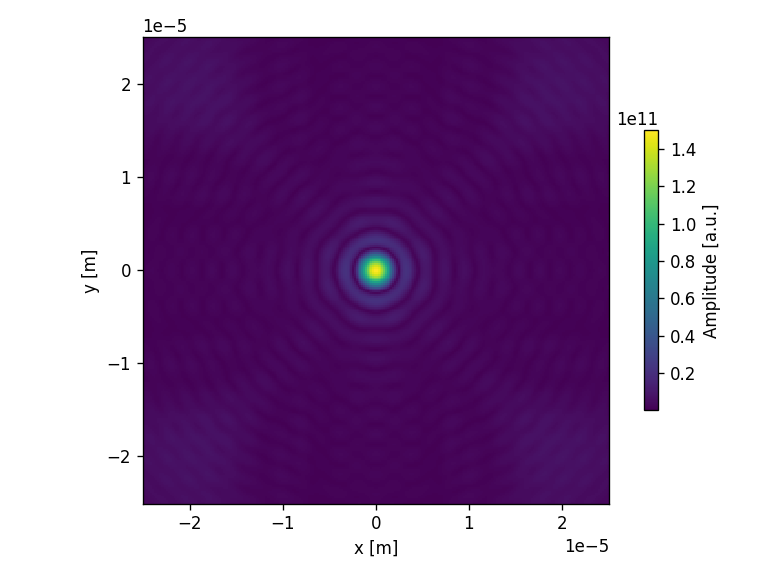
Point Spread Function (PSF)
[5]:
###Propagate field *10and calculate in plane YZ, using npix bins in Y
zmin = wavelength*10
zmax = 1.2* focal_length
nzs = 25

# Creates a screen in YZ plane with [-aperture_height/2, aperture_height/2] and [zmin, zmax] and
ymin, ymax = -aperture_height/2, aperture_height/2
xmin, xmax = -aperture_width/2, aperture_width/2


x_pixel, y_pixel = 256, 256

x = np.linspace(xmin, xmax, x_pixel )
y = np.linspace(ymin, ymax, y_pixel )
z = np.linspace(zmin, zmax, nzs)


screen = moe.field.Screen(x,y,z)
sfreq = moe.metrics.spatial_freq_space(screen)
# Propagate the field
EXYZ = moe.propagate.Bluestein(field, screen, wavelength)

Exy = moe.field.Screen(x,y,z)
Exy.screen = np.reshape(EXYZ.screen[:,:, int(focal_length/zmax*nzs)], (x_pixel,y_pixel,1))

moe.plotting.plot_screen_XY(Exy, which='amplitude')
Progress: [####################] 100.0%
Elapsed: 0:00:00.834339
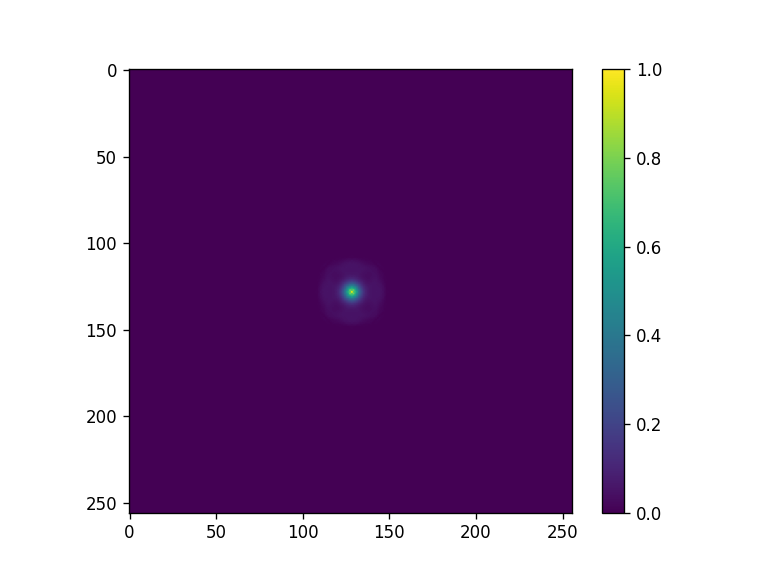
Optical Transfer Function (OTF)
[6]:
intensity = np.abs(screen.screen[:,:,-1])**2
#intensity = np.abs(Escreen)**2
norm_intensity = intensity/np.max(intensity)  # normalize intensity, not field

otf = sfft.fftshift(sfft.fft2(sfft.ifftshift(norm_intensity)))

center = (otf.shape[0] // 2, otf.shape[1] // 2)
otf_norm =  otf/np.abs(otf[center])


fig = plt.figure()

plt.imshow( np.abs(otf_norm) )
plt.colorbar()

plt.show()

fig.savefig("OTF.png")
[7]:
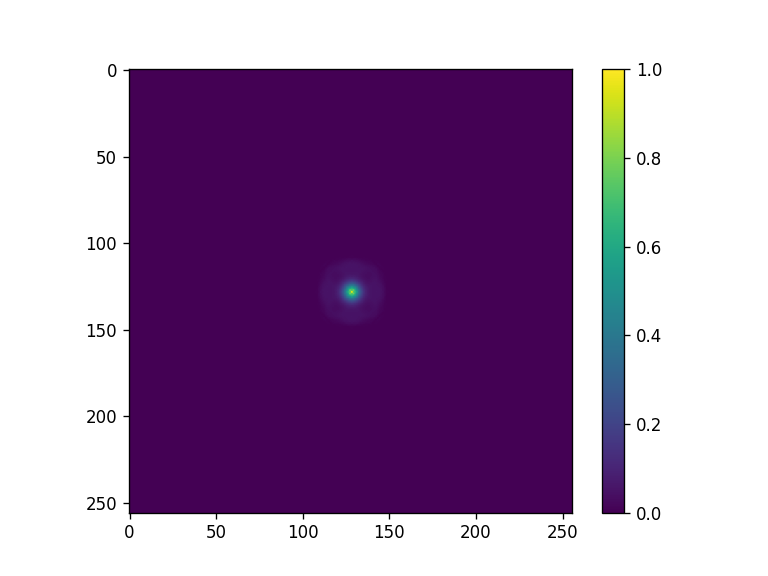
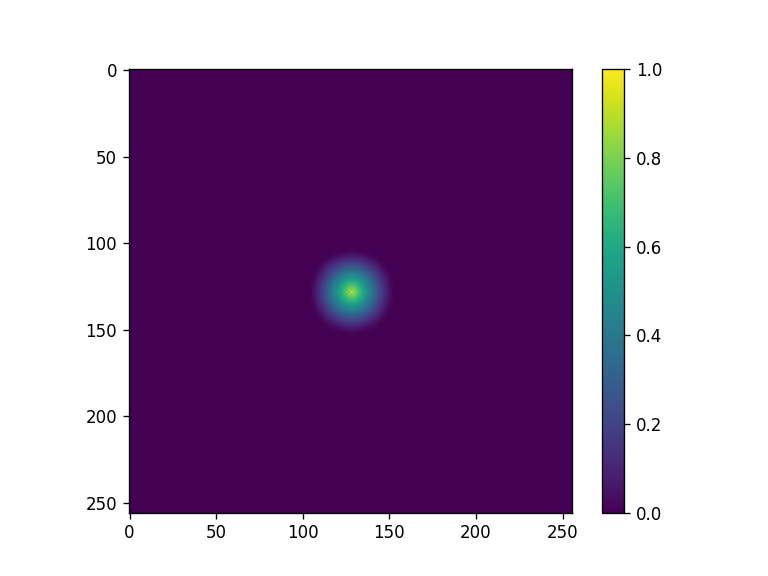
#Calculate the OTF out of focus and in focus
import scipy.fftpack as sfft

o1 = moe.metrics.calculate_OTF(np.abs(screen.screen[:,:,-1])**2 , plot_OTF=True);
o2 = moe.metrics.calculate_OTF(np.abs(Exy.screen[:,:,-1])**2  , plot_OTF=True);

D = np.max(Exy.x)*2
OTF_ideal = moe.metrics.theoretical_ideal_OTF(Exy, D, wavelength, focal_length)

fig = plt.figure()
plt.imshow( OTF_ideal)
C:\Users\jcunha377\Desktop\pyMOE-main-v2.0\notebooks\8 - Metrics\../..\pyMOE\metrics.py:161: RuntimeWarning: invalid value encountered in arccos
  OTF = (2 / np.pi) * (np.arccos(rho / fc) - (rho / fc) * np.sqrt(1 - (rho / fc)**2))
C:\Users\jcunha377\Desktop\pyMOE-main-v2.0\notebooks\8 - Metrics\../..\pyMOE\metrics.py:161: RuntimeWarning: invalid value encountered in sqrt
  OTF = (2 / np.pi) * (np.arccos(rho / fc) - (rho / fc) * np.sqrt(1 - (rho / fc)**2))
[7]:
<matplotlib.image.AxesImage at 0x227dfb6c410>
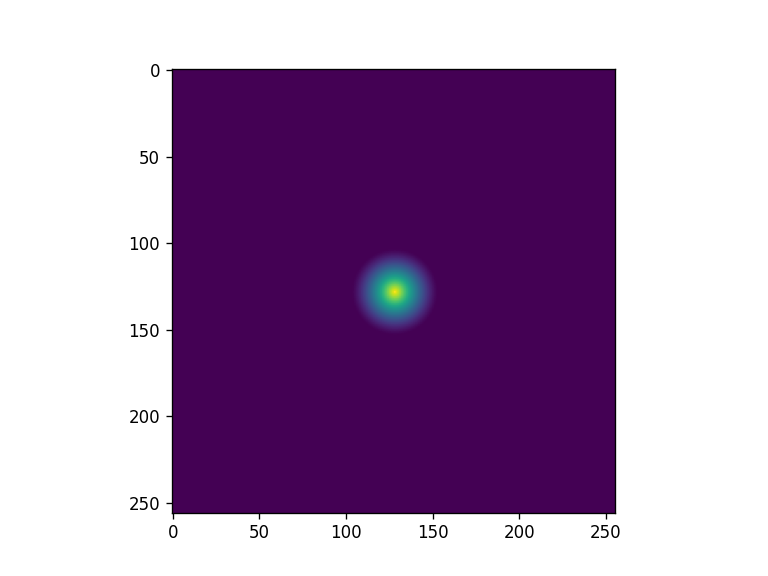
[8]:
plt.figure()

plt.imshow(np.abs(Exy.screen)**2)

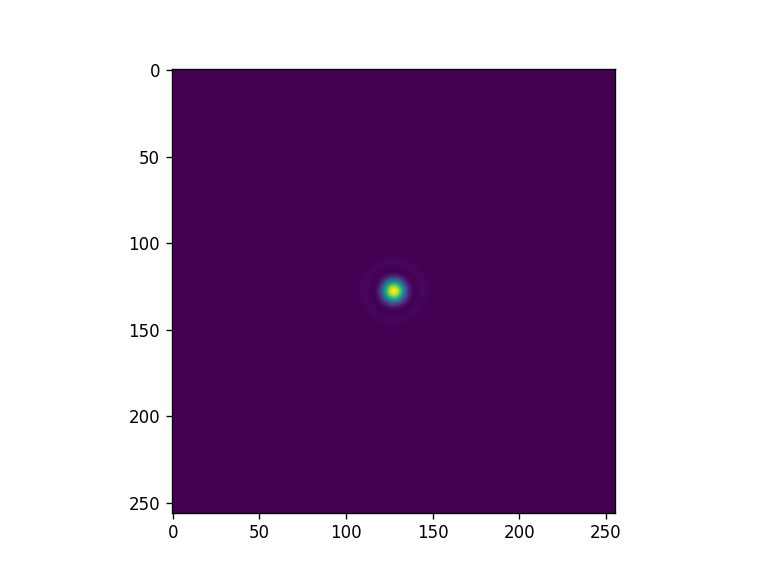
plt.figure()

plt.imshow(np.abs(o1) )

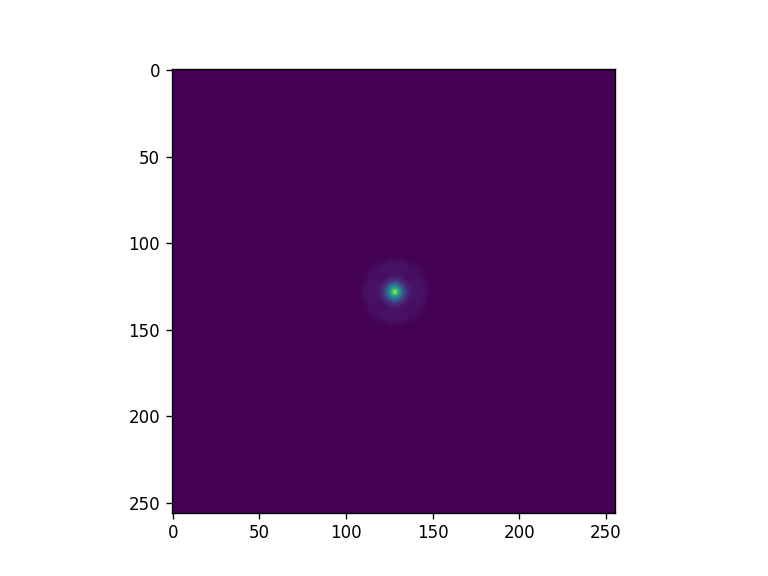
plt.figure()

plt.imshow(np.abs(o2) )

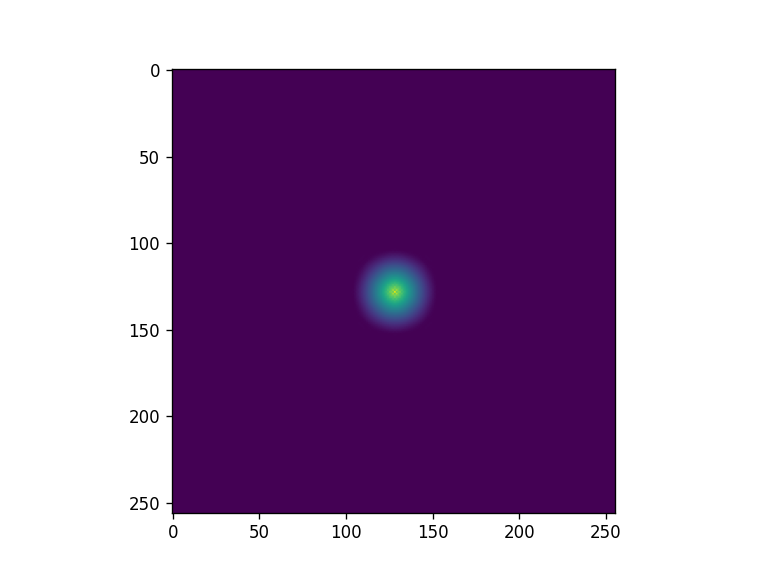
plt.figure()
plt.imshow(np.abs(OTF_ideal) )
[8]:
<matplotlib.image.AxesImage at 0x227dfc208d0>
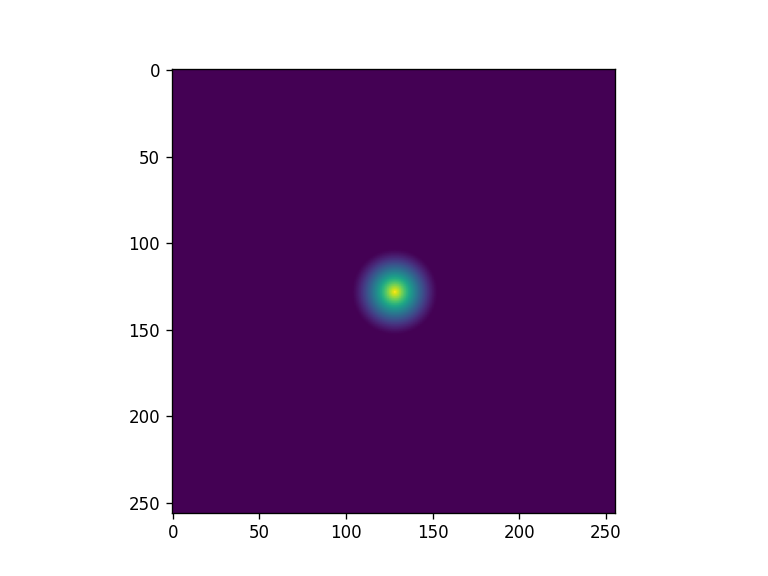
[9]:
max([max(Exy.x), max(Exy.y)])
Exy.z[0]


fig = plt.figure()
plt.imshow(np.abs(Exy.screen)**2)
[9]:
<matplotlib.image.AxesImage at 0x227dfac0d90>
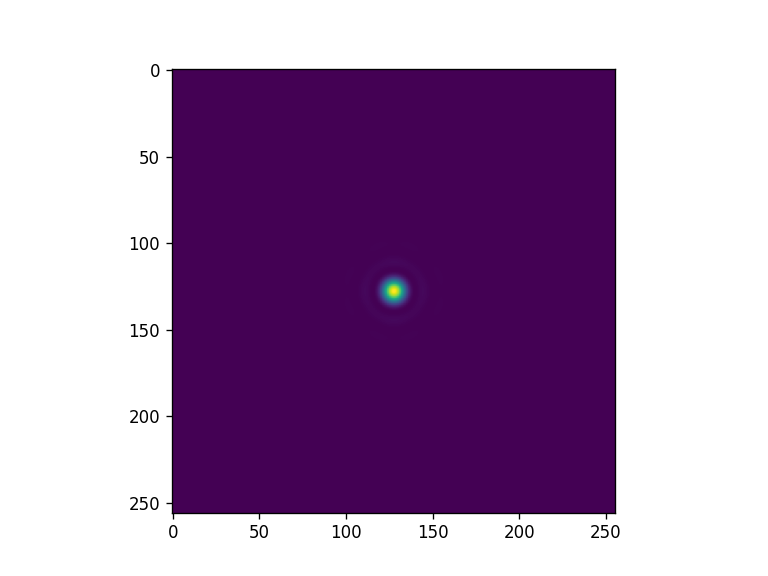
[10]:
fig= plt.figure()
plt.imshow(np.abs(Exy.screen) )
[10]:
<matplotlib.image.AxesImage at 0x227dfe2ec50>
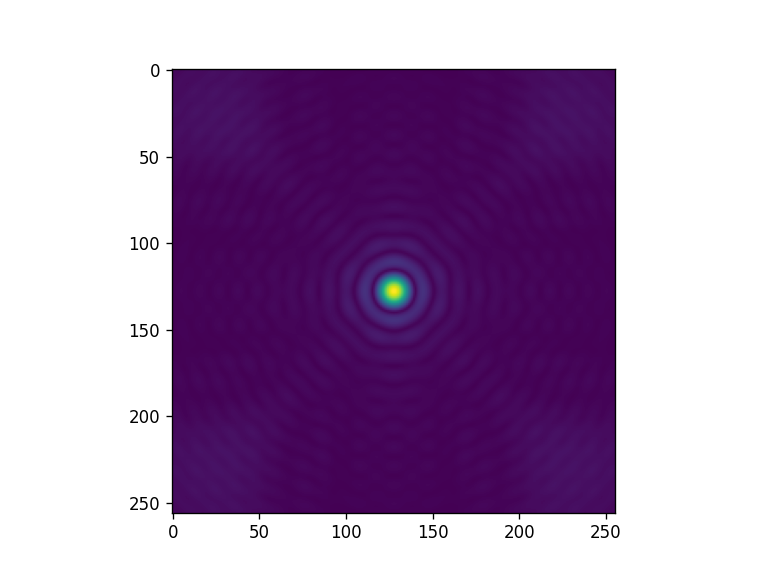
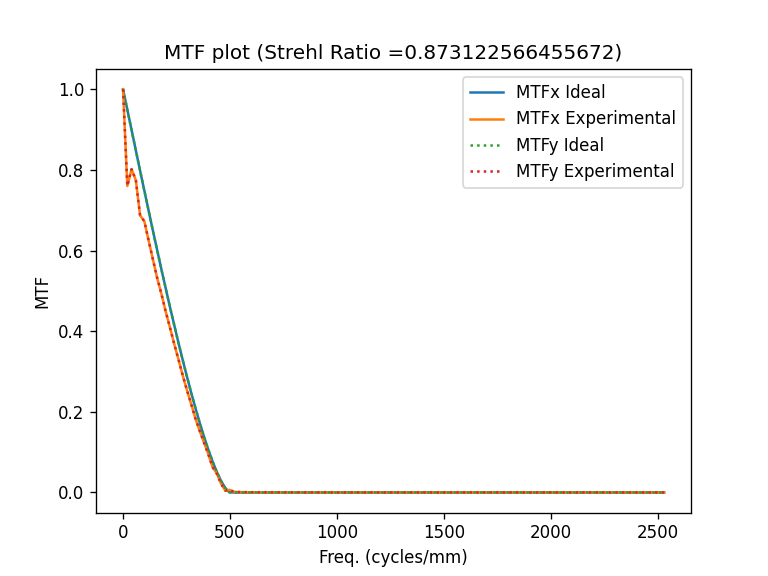
Modulation Transfer Function (MTF) and Phase Transfer Function (PTF) & Strehl ratio
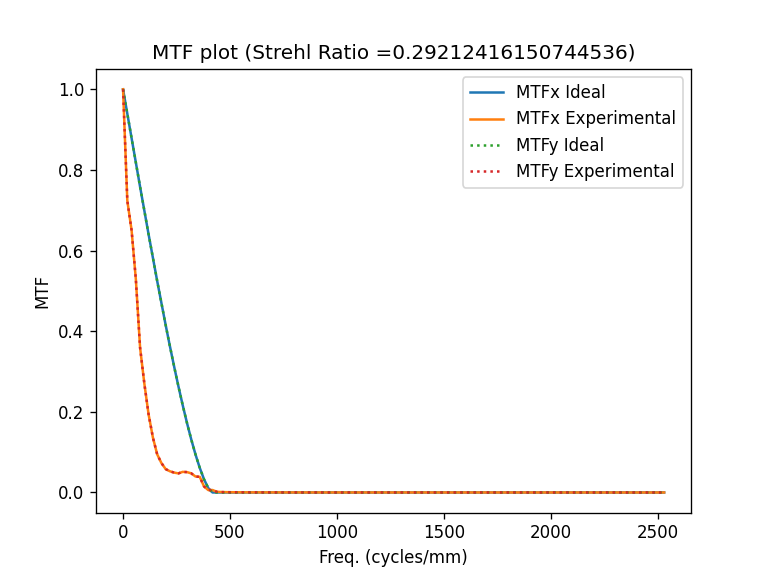
[11]:
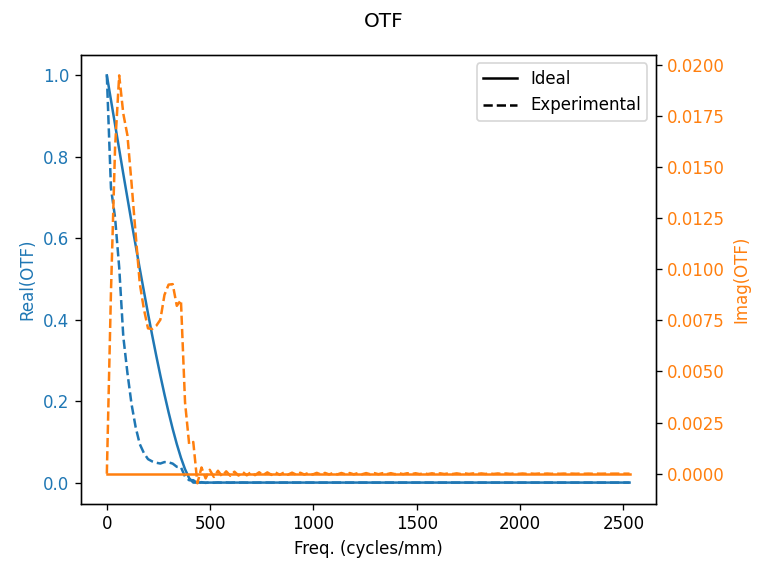
# MTF and OTF at DEFOCUSED PLANE

strehlv1 = moe.metrics.strehl_ratio(np.abs(screen.screen[:,:,-1] )**2, screen, max([max(Exy.x), max(Exy.y)])*2, wavelength, screen.z[-1], strehl_from_mtf=True, plot_MTF=True, plot_OTF=True)
[12]:
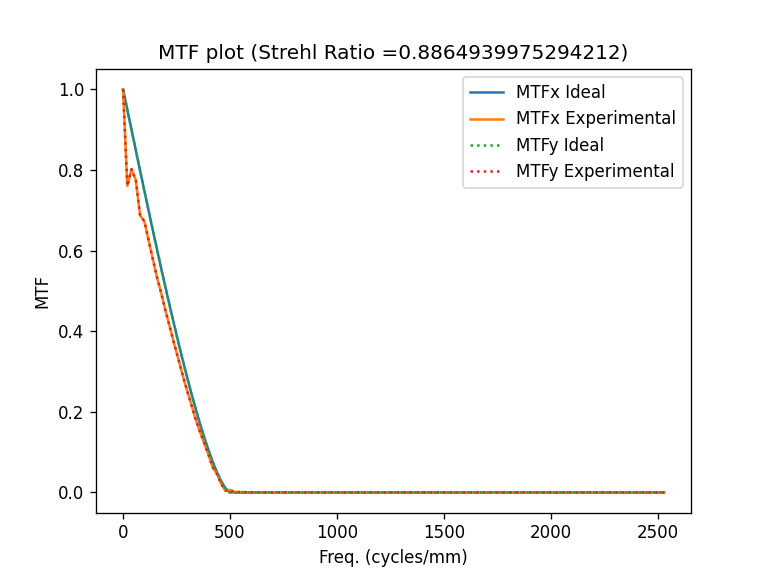
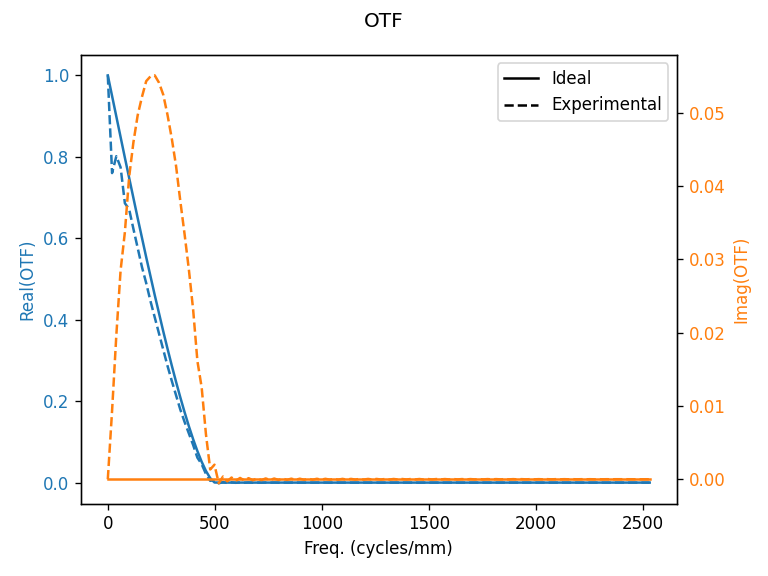
# MTF and OTF at FOCUSED PLANE

strehlv2 = moe.metrics.strehl_ratio(np.abs(Exy.screen[:,:,-1] )**2, Exy, max([max(Exy.x), max(Exy.y)])*2, wavelength, focal_length, strehl_from_mtf=True, plot_MTF=True, plot_OTF=True )
[13]:
strehlv1, strehlv2
[13]:
(0.29212416150744536, 0.8864939975294212)
[14]:
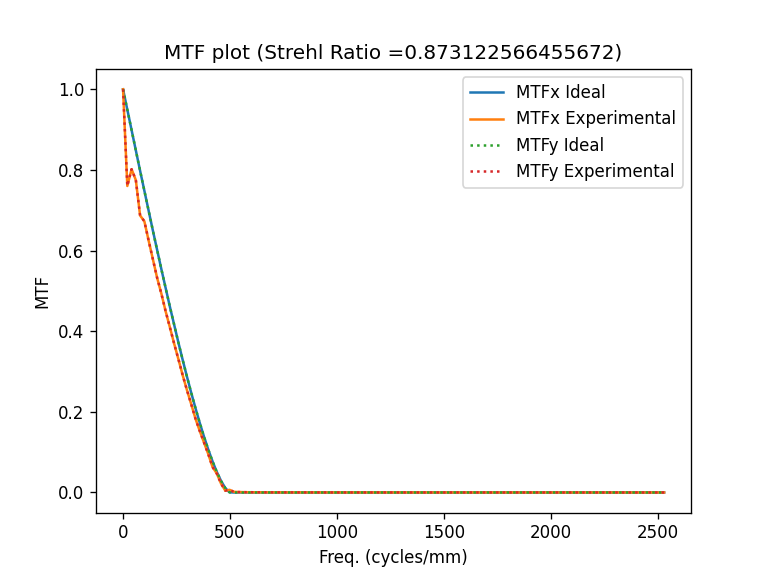
moe.metrics.strehl_ratio(np.abs(Exy.screen[:,:,-1])**2, screen, max([max(screen.x), max(screen.y)])*2, wavelength, focal_length, plot_MTF=True) ,\
moe.metrics.strehl_ratio(np.abs(Exy.screen[:,:,-1])**2, Exy, max([max(Exy.x), max(Exy.y)])*2, wavelength, focal_length, plot_MTF=True)
[14]:
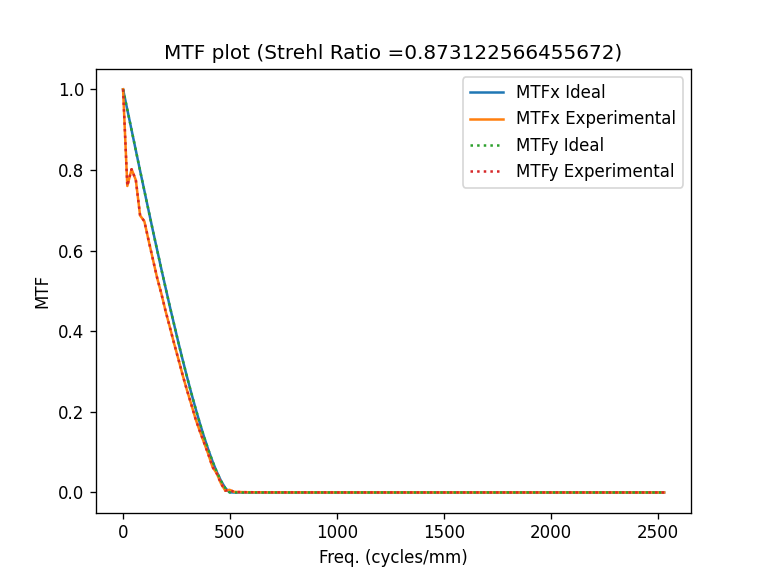
(0.873122566455672, 0.873122566455672)
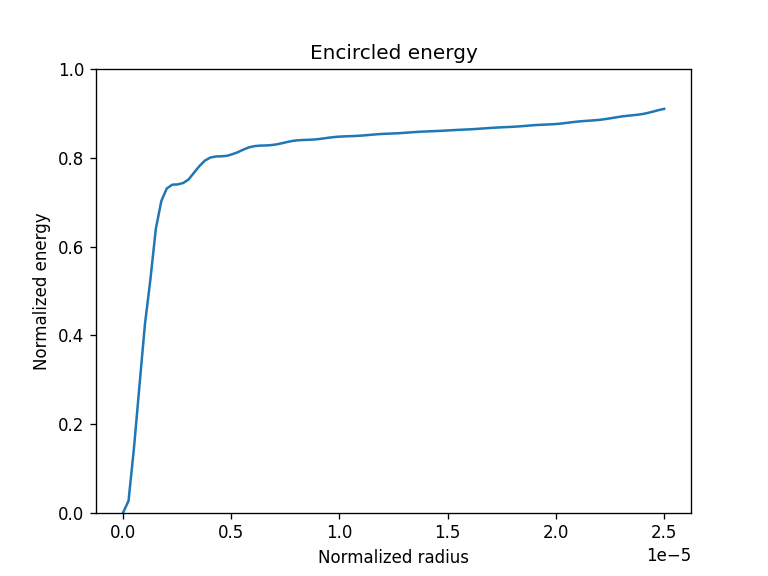
Encircled energy
[15]:
center=(0,0)

parray = np.linspace(0, aperture_width/2, 100)

enarray = [moe.metrics.encircled_energy(Exy, p) for p in parray]
enmax = moe.metrics.encircled_energy(Exy, 1.01)

fig = plt.figure()

plt.plot(parray, enarray/enmax)
plt.ylim([0,1])
plt.xlabel("Normalized radius")
plt.ylabel("Normalized energy")
plt.title("Encircled energy")
#plt.yscale("log")

#This is not exactly one, because other energy is lost to the square parts of the sensor


#The energy plateus at 0.5e-6, so makes sense to use that as p
[15]:
Text(0.5, 1.0, 'Encircled energy')
[16]:
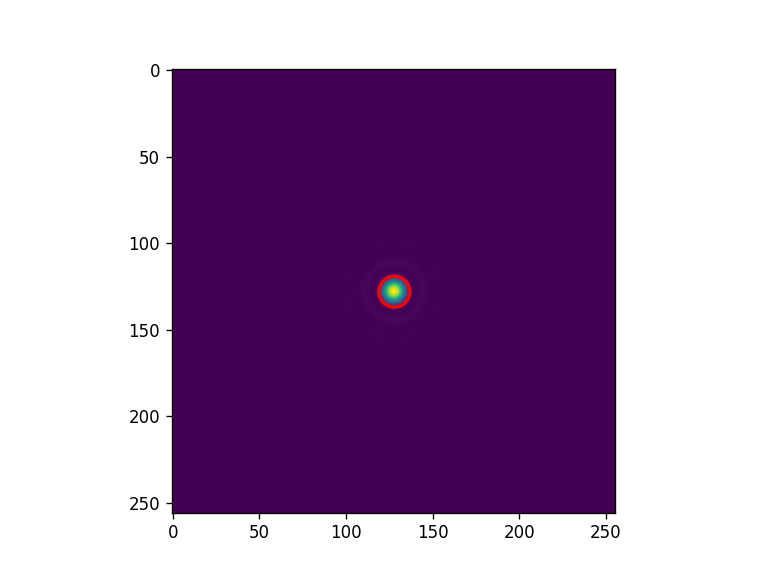
XY=np.abs(Exy.screen[:,:,-1])**2


largestpeak_height , largestpeak_width, position = moe.metrics.find_FWHM_2d(XY, prominence=0.5)

largestpeak_height , largestpeak_width, position
[16]:
(2.2475668705149547e+21, 17.791244475210718, array([128, 128], dtype=int64))
[17]:
from matplotlib.patches import Circle

fig = plt.figure()

plt.imshow(np.abs(XY))

# Get image dimensions
height, width = XY.shape

# Add central circle
circle = Circle((position[0], position[1]), radius=largestpeak_width/2, color='red', fill=False, linewidth=2)
plt.gca().add_patch(circle)
[17]:
<matplotlib.patches.Circle at 0x227dfa60b50>
[18]:
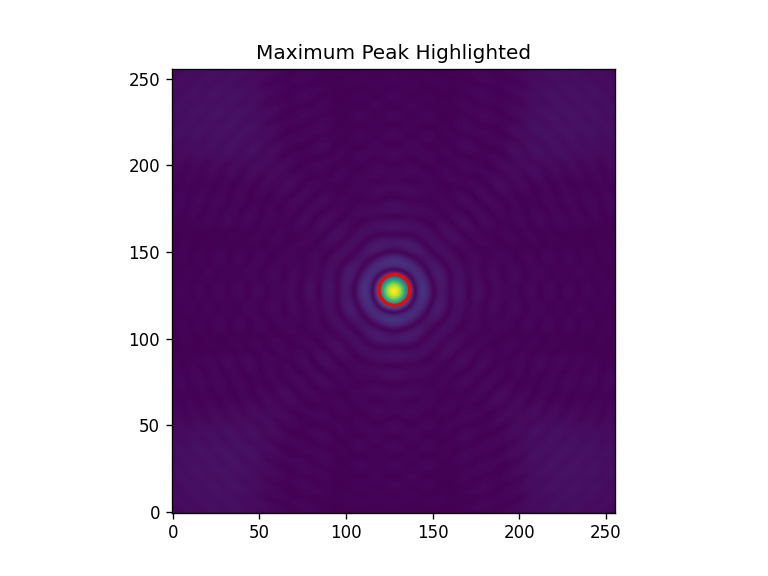
largestpeak_height , largestpeak_width, largestpeak_position = moe.metrics.find_FWHM_2d(np.abs(Exy.screen[:,:,-1])**2, prominence=0.5)


from matplotlib.patches import Circle

fig, ax = plt.subplots()
ax.imshow(np.abs(Exy.screen[:,:,-1]),  origin='lower')

# Draw the circle
circle = Circle((largestpeak_position[0], largestpeak_position[1]),  # x, y
                radius=largestpeak_width/2, color='red', fill=False, linewidth=2)
ax.add_patch(circle)

# Optional: mark the center
#ax.plot(largestpeak_position[0], largestpeak_position[1], 'ro')  # center dot

plt.title("Maximum Peak Highlighted")
plt.show()
[19]:
##encircled energy at 1 FWHM

one_fwhm = moe.metrics.encircled_energy(Exy, (width/2)*pixsize)/moe.metrics.encircled_energy(Exy, 1.01)

##encircled energy at 0.5 FWHM

half_fwhm = moe.metrics.encircled_energy(Exy, (width/2)*pixsize*0.5)/moe.metrics.encircled_energy(Exy, 1.01)


(width/2)*pixsize, one_fwhm, half_fwhm
#This is consistent with the plateauing that is seen in the encircled energy
[19]:
(0.000128, 1.0, 1.0)
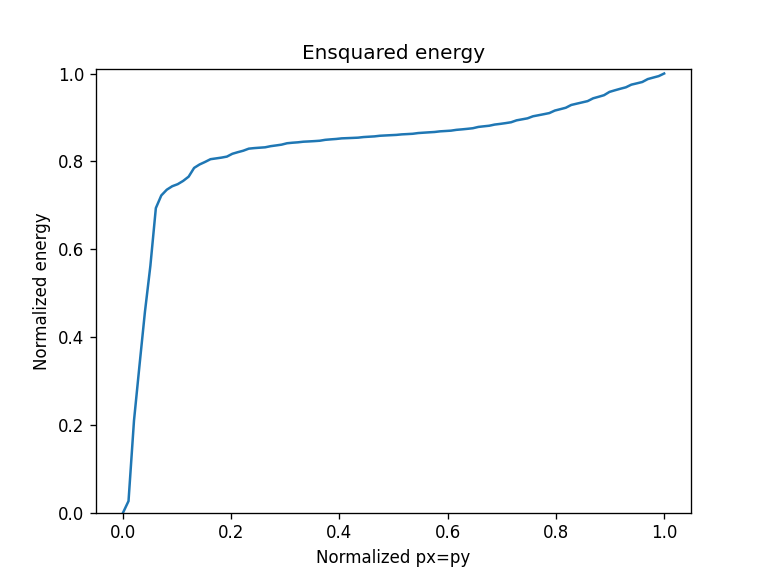
Ensquared energy
[20]:
center=(0,0)

parray = np.linspace(0, aperture_width/2, 100)

enarray = [moe.metrics.ensquared_energy(Exy, p, p) for p in parray]
enmax = moe.metrics.ensquared_energy(Exy, 1,1)

fig = plt.figure()

plt.plot(parray/(aperture_width/2), enarray/enmax)
plt.ylim([0,1.01])
plt.xlabel("Normalized px=py")
plt.ylabel("Normalized energy")
plt.title("Ensquared energy")
[20]:
Text(0.5, 1.0, 'Ensquared energy')
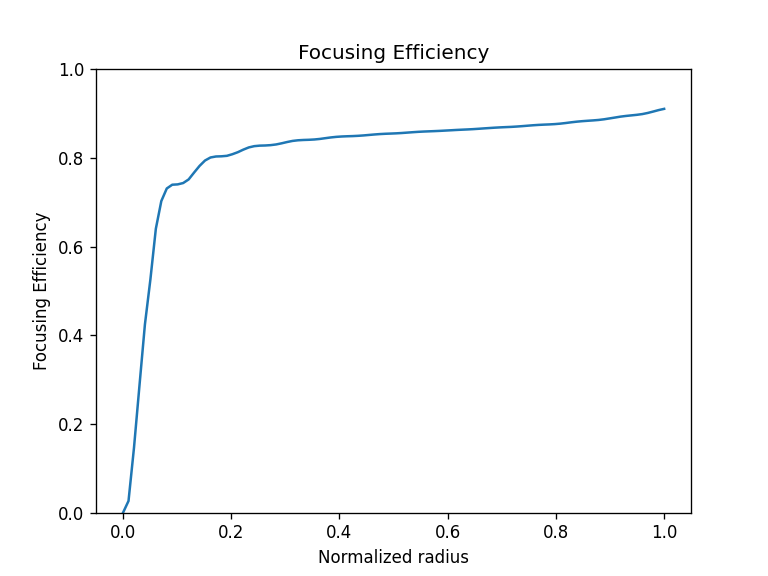
Focusing Efficiency
[21]:
center=(0,0)

parray = np.linspace(0, aperture_width/2, 100)

#Should give the same as the enclircled energy
farray1 = [moe.metrics.focus_efficiency(Exy, p,  encircled_energy(Exy, 1.01),center=(0,0),) for p in parray]

fig = plt.figure()

plt.plot(parray/(aperture_width/2), farray1)
plt.ylim([0,1])
plt.xlabel("Normalized radius")
plt.ylabel("Focusing Efficiency")
plt.title("Focusing Efficiency")
#plt.yscale("log")
[21]:
Text(0.5, 1.0, 'Focusing Efficiency')
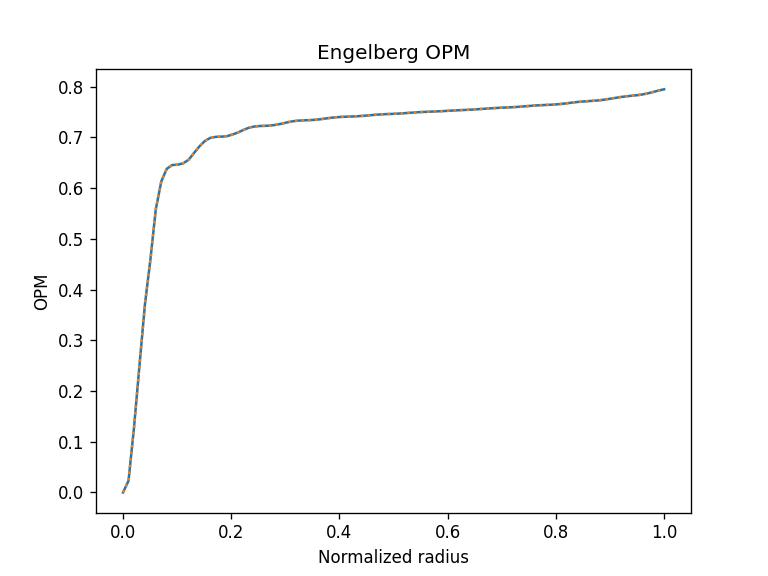
Optical Performance Metric (OPM)
[22]:
#Engelberg metric, check original paper for more detail

center=(0,0)

parray = np.linspace(0, aperture_width/2, 100)

farray2 = [moe.metrics.Engelberg_OPM(Exy, p,  moe.metrics.encircled_energy(Exy, 1.01),1, wavelength, z = focal_length) for p in parray]
strehlr = moe.metrics.strehl_ratio(np.abs(Exy.screen[:,:,-1])**2, Exy, max([max(Exy.x), max(Exy.y)])*2, wavelength, focal_length, plot_MTF=True)

fig = plt.figure()

plt.plot(parray/(aperture_width/2), farray2)
plt.plot(parray/(aperture_width/2), strehlr*np.array(farray1), ':' )
#plt.ylim([0,1])
plt.xlabel("Normalized radius")
plt.ylabel("OPM")
plt.title("Engelberg OPM")
[22]:
Text(0.5, 1.0, 'Engelberg OPM')
[23]:
strehlr = moe.metrics.strehl_ratio(np.abs(Exy.screen[:,:,0])**2, screen, max([max(Exy.x), max(Exy.y)])*2, wavelength, focal_length, plot_MTF=True)
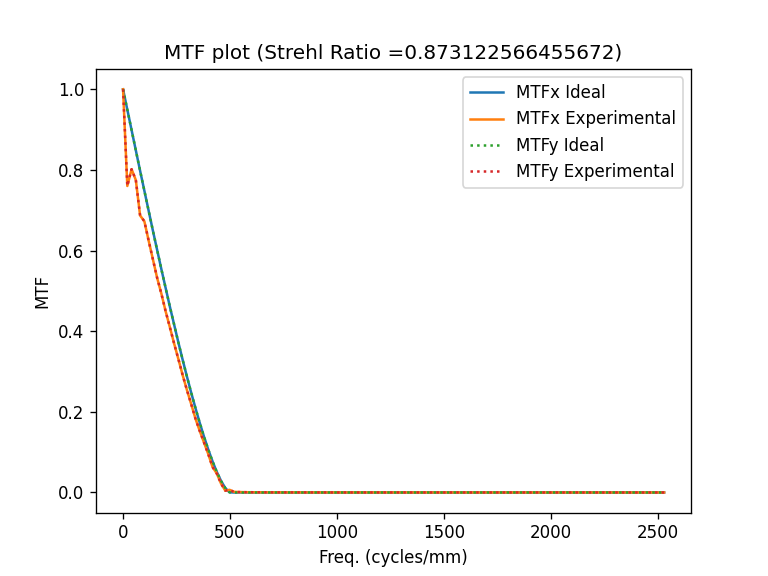
Comparisons to theoretical (analytical)
[24]:
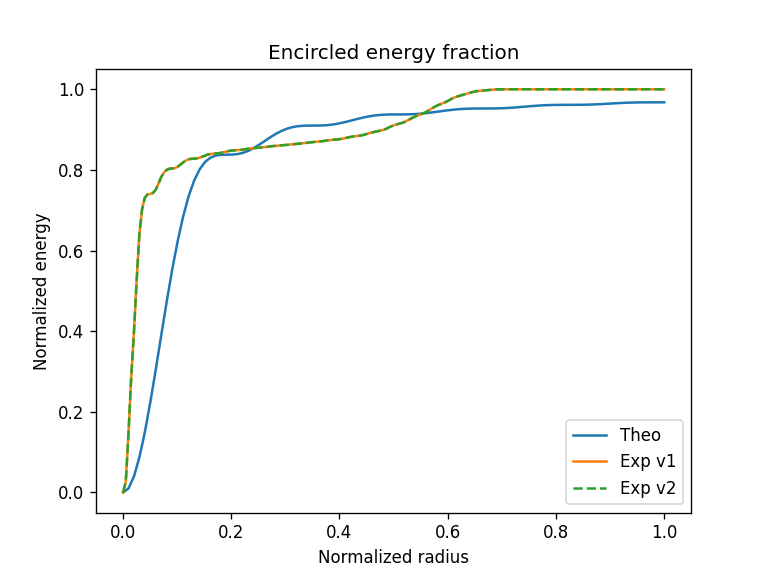
## RESULT TO BE CHECKED, MISMATCH MAYBE DUE TO DISTINCT DEFINITION OF RADIUS p ??

center=(0,0)

parray1 = np.linspace(0, aperture_width, 200)

enarray = [moe.metrics.encircled_energy(Exy, p) for p in parray1]
enmax = moe.metrics.encircled_energy(Exy, 1.01)


parray2 = np.linspace(0, aperture_width*10, 100)
enarray_theo = [moe.metrics.theoretical_encircled_energy(Exy, p) for p in parray2]
enmaxtheo = moe.metrics.theoretical_encircled_energy(Exy, 1.01)


enarray2 = [moe.metrics.encircled_energy(Exy, p) for p in parray1]
enmax2 = moe.metrics.encircled_energy(Exy, 1.01)


fig = plt.figure()

plt.plot(parray2/parray2.max(), enarray_theo/enmaxtheo, label="Theo")
plt.plot(parray1/parray1.max(), enarray/enmax, label = "Exp v1")

plt.plot(parray1/parray1.max(), enarray2/enmax2 , '--', label ="Exp v2")

plt.xlabel("Normalized radius")
plt.ylabel("Normalized energy")
plt.title("Encircled energy fraction")

plt.legend()

#This is not exactly one, because other energy is lost to the square parts of the sensor
[24]:
<matplotlib.legend.Legend at 0x227e1f03690>
[25]:
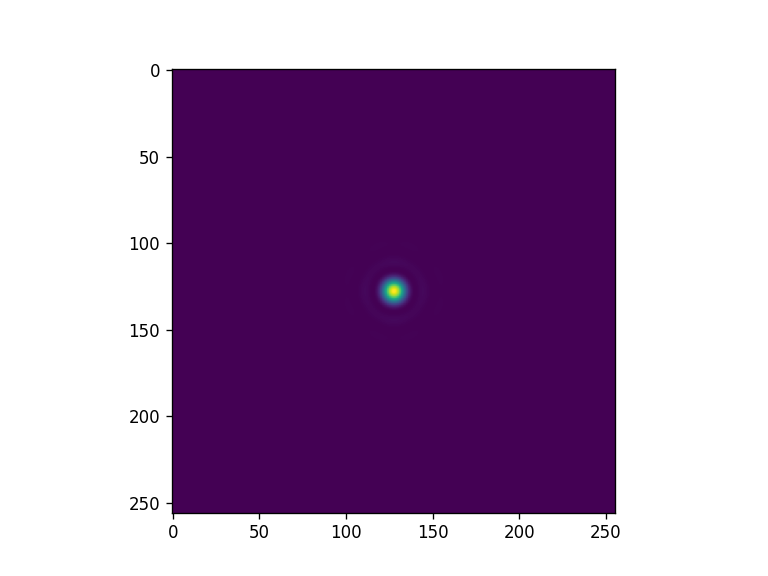
fig = plt.figure()
plt.imshow(np.abs(Exy.screen[:,:,-1])**2)
[25]:
<matplotlib.image.AxesImage at 0x227e11b8d90>
[26]:
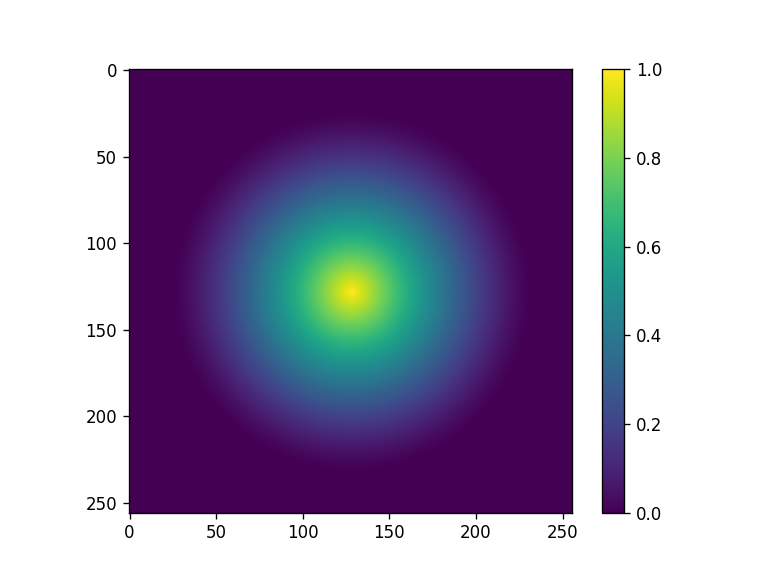
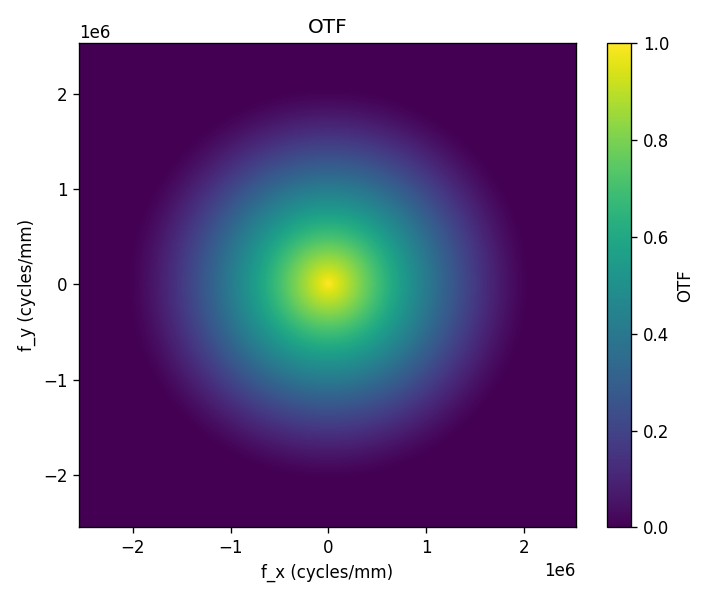
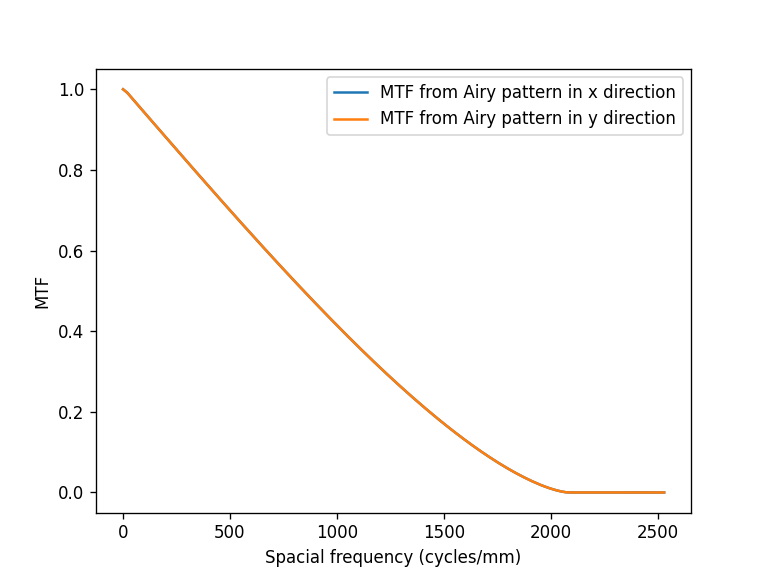
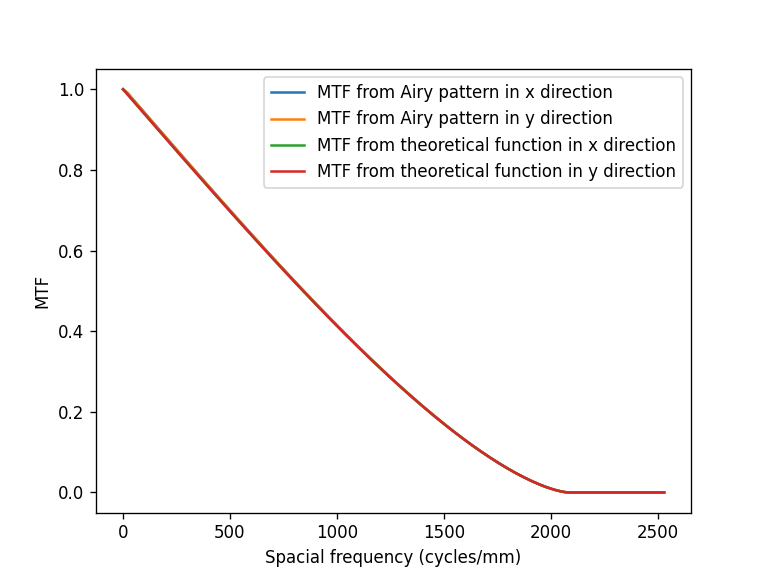
#Sanity check with theoretical Airy pattern MTF,
# here the theoretical and calculated MTFs should give the same with unitary Strehl ratio

D = np.max(Exy.x)*2

wavelength = 200e-9  # Wavelength in meters (e.g., 550 nm)

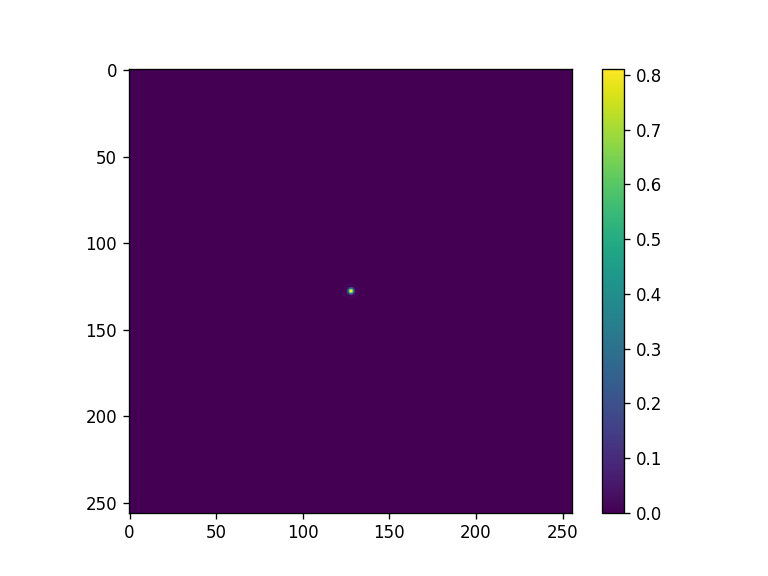
intensity_circular = intensity_theo_Airy(screen, D*2, wavelength, z=1)


fig = plt.figure()
plt.imshow(intensity_circular  )
plt.colorbar()

OTF_circular = calculate_OTF(intensity_circular)


fig = plt.figure()
plt.imshow(np.abs(OTF_circular) )
plt.colorbar()

fig = plt.figure()

N = 512
dx = 10e-6  # pixel pitch in meters
dy = 10e-6


# Plot
plt.figure(figsize=(6, 5))
plt.imshow(np.abs(OTF_circular), extent=(np.min(Exy.fx), np.max(Exy.fx), np.min(Exy.fy), np.max(Exy.fy)),
           origin='lower', cmap='viridis', aspect='auto')
plt.colorbar(label='OTF')
plt.xlabel('f_x (cycles/mm)')
plt.ylabel('f_y (cycles/mm)')
plt.title('OTF')
plt.tight_layout()
plt.show()
Picking up the last z propagated assumed to be the screen position
<Figure size 768x576 with 0 Axes>
[27]:
mtf, mtfx1, mtfy1 = moe.metrics.MTF_from_OTF(OTF_circular)


fx, fy = screen.fx*1e-3, screen.fy *1e-3

fig = plt.figure()
plt.plot(fx[np.where(fx>=0)],  mtfx1, label="MTF from Airy pattern in x direction")
plt.plot(fy[np.where(fy>=0)],  mtfy1, label="MTF from Airy pattern in y direction")
plt.xlabel("Spacial frequency (cycles/mm)")
plt.ylabel("MTF")

plt.legend()
[27]:
<matplotlib.legend.Legend at 0x227de539650>
[28]:
otf = moe.metrics.theoretical_ideal_OTF(screen, D*2, wavelength, screen.z[-1])

mtf, mtfx2, mtfy2 = moe.metrics.MTF_from_OTF(otf)
[29]:
fx = screen.fx*1e-3
fy = screen.fy*1e-3

fig = plt.figure()
plt.plot(fx[np.where(fx>=0)],  mtfx1, label="MTF from Airy pattern in x direction")
plt.plot(fy[np.where(fy>=0)],  mtfy1, label="MTF from Airy pattern in y direction")
plt.plot(fx[np.where(fx>=0)],  mtfx2, label="MTF from theoretical function in x direction")
plt.plot(fy[np.where(fy>=0)],  mtfy2, label="MTF from theoretical function in y direction")
plt.xlabel("Spacial frequency (cycles/mm)")
plt.ylabel("MTF")

plt.legend()
[29]:
<matplotlib.legend.Legend at 0x227e300ddd0>
[30]:
#This should give 1

moe.metrics.strehl_ratio(intensity_circular, screen, D*2, wavelength, z = screen.z[-1])
[30]:
0.8138093632949268